How to Import Ductile Iron Manhole Covers from China: A Step-by-Step Guide
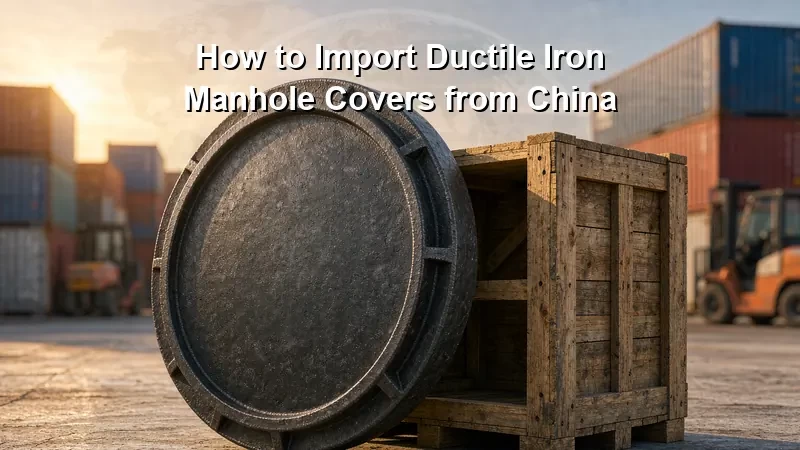
Table of Contents
Why Import Manhole Covers from China?
Step 1 — Define the Specification Before You Contact Anyone
Step 2 — Find and Vet a China Manhole Cover Supplier
Step 3 — Request Samples and Mill Test Reports
Step 4 — Negotiate Terms and Sign the Contract
Step 5 — Arrange Inspection Before Shipment
Step 6 — Shipping, HS Codes and Customs Clearance
Step 7 — Receiving, Acceptance and Claims
Seven Costly Import Mistakes to Avoid
Frequently Asked Questions
The Bottom Line
Importing manhole covers from China can cut project costs substantially—if you specify correctly and vet the supplier. This guide walks through every step from drawing to delivery.
| Quick answer: To import manhole covers from China, define the EN 124 load class and dimensions first, shortlist verified suppliers, request samples and test reports, agree Incoterms and payment terms in a written contract, inspect before shipment, then handle HS classification and customs documents. Most problems come from vague specifications and skipped inspection—not from the manufacturing itself. |
Why Import Manhole Covers from China?
China is the world's largest producer of cast iron manhole covers, with mature foundry clusters, extensive mould libraries and high production capacity. For municipal projects and distributors, importing directly can remove several layers of margin and bring unit costs down significantly, especially on large-volume orders.
The trade-off is distance. A locally purchased cover arrives in days; an imported one involves specification alignment, production, inspection, sea freight and customs. A well-run manhole cover import programme saves money; a rushed one produces a container of covers that fail the specification. This guide is about making the first outcome the normal one.
Step 1 — Define the Specification Before You Contact Anyone
The single biggest source of import disputes is an incomplete specification. "Ductile iron manhole cover, D400" is not enough. Before you approach a single China manhole cover supplier, write down the following:
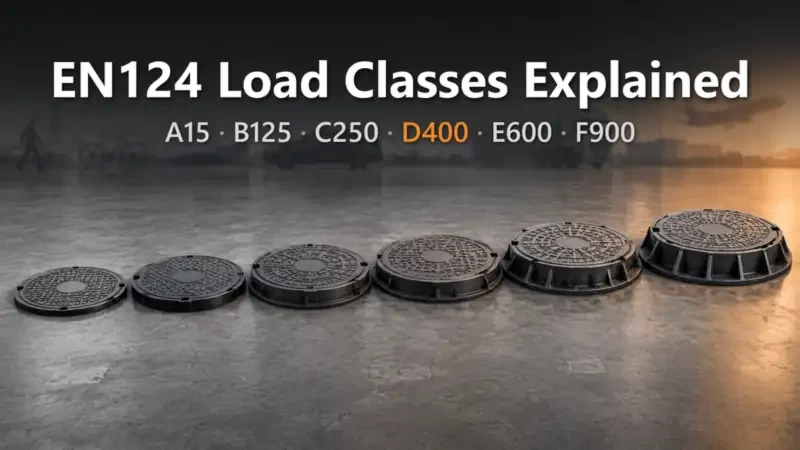
Load class: the EN 124 class (A15 to F900) required for the actual installation.
Clear opening and frame size: state both; a cover and its frame are different dimensions.
Material and grade: ductile iron to ASTM A536 or EN 1563, with the grade called out.
Standard and testing: which standard governs, and what test certificates must accompany each batch.
Finish and marking: anti-slip pattern, coating, casting marks and any custom logo.
Accessories: hinges, locks, lifting keys, secondary safety devices.
Where possible, issue a dimensioned drawing rather than a text description. A supplier quoting against a drawing has far less room to interpret than one quoting against a sentence.
Table 1 — EN 124 load classes and typical applications
| Class | Test load | Typical application |
|---|---|---|
| A15 | 15 kN | Pedestrian areas, gardens |
| B125 | 125 kN | Footways, cycle lanes, parking |
| C250 | 250 kN | Kerbside channels, light traffic |
| D400 | 400 kN | Road carriageways, the common municipal choice |
| E600 | 600 kN | Ports, docks, heavy industrial areas |
| F900 | 900 kN | Aircraft pavements, extreme duty |
Step 2 — Find and Vet a China Manhole Cover Supplier
Sourcing platforms will return dozens of suppliers; the challenge is separating trading companies from actual foundries and confirming that a factory can make your specification. Check four things:
Manufacturing capability: request the factory profile, workshop photos, melting equipment and annual capacity.
Product range: a supplier already making your load class and size is far safer than one learning on your order.
Certification: ISO 9001 and product test reports to the relevant standard; confirm the reports are recent and from a recognised lab.
Export track record: ask for reference shipments to your country and a list of similar projects.
Video calls and factory audits are worth the time. A supplier who walks you through the production line and shows in-process quality checks is giving you evidence, not promises. Be cautious of prices dramatically below the market—they usually signal a downgrade in material or load class.
Step 3 — Request Samples and Mill Test Reports
Never skip samples on a first order. Pay for one or two covers, have them shipped by courier, and inspect them personally: check the casting surface, dimensional accuracy, anti-slip texture, frame fit and marking. Send a sample to a local lab if the project requires independent verification.
At the same time request a mill test report and a mechanical test certificate for the batch: tensile strength, yield strength and elongation against ASTM A536 or EN 1563. A credible China manhole cover supplier will provide these without hesitation. Refusal or "we can get a certificate later" is a clear warning sign.
Step 4 — Negotiate Terms and Sign the Contract
Once the sample is approved, put every commercial term in writing. A purchase contract should state:
Unit price and currency, with validity and raw-material adjustment clauses if relevant.
Incoterms 2020: EXW, FOB, CIF or DDP—these decide who pays freight and who bears risk at each stage.
Payment terms: a common structure is a deposit with balance against inspection report or bill of lading.
Lead time and penalty for late delivery.
Quality clause: the exact standard, acceptable tolerance and the remedy for non-conforming goods.
Packaging and marking requirements for sea freight.
Table 2 — Common Incoterms for a manhole cover import
| Term | Seller covers | Buyer covers | When it suits |
|---|---|---|---|
| EXW | Goods at factory | Everything from factory gate | You have a freight forwarder in China |
| FOB | Loading on board at port | Main freight, insurance, import | Most common for experienced importers |
| CIF | Freight and insurance to destination port | Import duty, clearance, inland | Buyer wants a landed-port price |
| DDP | Delivery duty paid to your door | Nothing except unloading | Hands-off, but seller controls clearance |
Step 5 — Arrange Inspection Before Shipment
Pre-shipment inspection is the cheapest insurance in the whole process. Hire a third-party inspector or send your own engineer to the factory before the container is sealed. Check dimensional conformity, load-class marking, batch test reports, quantity and packaging. A short inspection report protects you if a dispute arises later.
For a first order, consider a loading supervision: the inspector confirms the correct goods are loaded and seals the container. This prevents the common problem of a good sample followed by a weaker production batch.
Step 6 — Shipping, HS Codes and Customs Clearance
Manhole covers are normally shipped as break-bulk or in containers depending on volume and weight. Prepare the commercial invoice, packing list, bill of lading, certificate of origin and the product test reports. Confirm the correct HS code for your destination country with a customs broker—classification affects duty rate and any anti-dumping measures.
Sea freight from China to Europe or North America typically takes several weeks, so build the lead time into your project schedule. Customs clearance can add further days if documents are inconsistent. Make sure the invoice description matches the contract and the test reports; mismatches are the main cause of delays.
Step 7 — Receiving, Acceptance and Claims
On arrival, inspect the shipment before releasing payment or signing off: count the pieces, compare marking and dimensions with the approved sample, and check for transit damage. Keep photographs and the inspection report. If goods are non-conforming, notify the supplier immediately with evidence—claims become much harder once the goods have been installed.
Store covers flat and dry until installation, and keep the batch test reports linked to the project records. For municipal work, this traceability is often a contractual requirement in itself.
Seven Costly Import Mistakes to Avoid
Most import problems repeat themselves. Avoid these seven:
Vague specification—no drawing, no load class, no clear opening dimension.
Price-only supplier choice—the lowest quote often hides a material or standard downgrade.
No samples—ordering a full container on the strength of a catalogue photo.
No pre-shipment inspection—discovering the problem at the port is too late.
Unclear Incoterms—disagreement over who pays freight, insurance and duty.
Ignoring HS classification—unexpected duty or a compliance hold at customs.
No claim clause—no agreed remedy when the goods fail the specification.
Frequently Asked Questions
These are the questions buyers most often ask before their first container order.
How much can I save importing manhole covers from China?
Savings depend on load class, volume, material prices and freight. Direct factory pricing can be materially lower than local distribution, but freight, duty and inspection must be included in the comparison. Always compare landed cost, not unit price.
What is the typical minimum order quantity?
It varies by supplier and whether your size is a standard mould. Standard designs often accept smaller mixed containers; custom dimensions usually require a mould fee and a higher minimum. Ask the supplier to state the MOQ per item in writing.
Which load class is right for a public road?
EN 124 class D400 is the usual minimum for carriageways. Pedestrian areas may use A15 or B125; ports and heavy industrial zones may require E600 or F900. Match the class to the real traffic, not the cheapest option.
Do Chinese suppliers provide EN 124 test certificates?
Many do. Ask for a recent certificate from a recognised laboratory for the exact product and load class, and verify that the test report matches the goods you are buying. Independent pre-shipment testing is an option for the first order.
What documents do I need for customs clearance?
Typically a commercial invoice, packing list, bill of lading, certificate of origin and product test reports. Your customs broker will confirm any additional documents required in your country and the correct HS code.
The Bottom Line
Importing manhole covers from China is straightforward when the process is treated as a controlled sequence: a precise specification, a vetted supplier, approved samples, a written contract, pre-shipment inspection and correct customs paperwork. Each step is simple; skipping them is what makes the process risky.
The goal is not the lowest unit price but the lowest landed cost with the right product arriving on site. For municipal buyers and contractors, that means a cover that passes inspection, meets EN 124 and performs for decades.
Next step: prepare a one-page specification drawing and a shortlist of three suppliers, then request samples and batch test reports from each before placing a container order.