Ductile Iron Manhole Cover Price Guide: What Affects the Cost
A ductile iron manhole cover price depends on load class, size, grade, certification and order volume. This guide breaks down every cost driver—and shows how to read a price list without surprises.
Table of Contents
What Does a Ductile Iron Manhole Cover Actually Cost?
Factor 1: EN 124 Load Class (incl. D400 manhole cover price)
Factor 2: Clear Opening and Frame Size
Factor 3: Material Grade and Casting Quality
Factor 4: Certification and Test Documentation
Factor 5: Coatings, Locking and Anti-Rattle Options
Factor 6: Order Volume, Tooling and Freight
How to Compare a Manhole Cover Price List Fairly
Hidden Costs That Change the Real Price
Frequently Asked Questions
The Bottom Line
What Does a Ductile Iron Manhole Cover Actually Cost?
There is no single number, because "manhole cover" covers everything from a 350 mm garden lid to a 900 mm heavy-duty road casting. What buyers can rely on is a typical ex-works range by EN 124 class. The table below is an indicative market reference for 2026, based on common 600 mm round covers in standard ductile iron, before coatings, test certificates, tooling and shipping. Actual quotations vary with region, volume and specification.
Table 1 — Indicative ex-works unit price by EN 124 class (600 mm round)
| EN 124 class | Typical load | Common size | Indicative unit price (ex-works) |
|---|---|---|---|
| A15 | 15 kN | 350–450 mm | US$25–$55 |
| B125 | 125 kN | 500–600 mm | US$40–$85 |
| C250 | 250 kN | 600 mm | US$60–$120 |
| D400 | 400 kN | 600 mm | US$90–$180 |
| E600 | 600 kN | 600–800 mm | US$180–$350 |
| F900 | 900 kN | 800–900 mm | US$350–$700+ |
How to read these numbers: they are a starting point for comparison, not a quotation. A D400 manhole cover price at the lower end of the band usually means a lighter casting, a less rigorous test regime or a supplier quoting without certification. A price at the upper end often includes heavier section, machined seating and documented load testing.
Price disclaimer: all figures are indicative market ranges for general reference, not supplier offers. Confirm actual pricing against your drawing, volume and delivery terms.
Factor 1: EN 124 Load Class
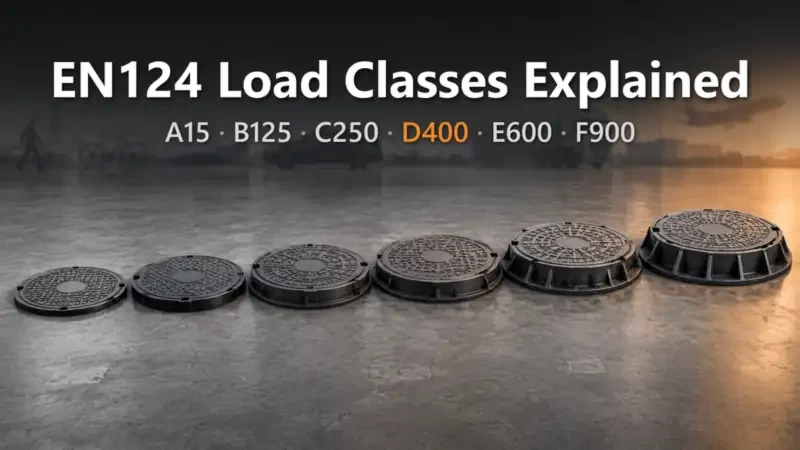
Load class is the single biggest price driver. EN 124 defines six classes from A15 (15 kN) to F900 (900 kN). Each step up generally means more iron in the casting, a stronger frame section and more demanding proof-load testing.
A15 / B125 — pedestrian and light-vehicle areas. Thin sections, lowest material cost.
C250 — kerbside and lightly trafficked edges. Moderate weight increase.
D400 — the workhorse for road carriageways. This is where most municipal budgets sit.
E600 / F900 — docks, industrial yards, aircraft pavements. Heavy castings, specialist testing, a step-change in price.
Where teams overspend: specifying E600 "to be safe" for a residential road. Where they underspend: using B125 on a shoulder that construction traffic actually uses. Both show up in the total cost, not just the purchase order.
D400 manhole cover price in detail
D400 is the most quoted class in municipal and commercial projects, so it is worth isolating. For a standard 600 mm clear-opening round cover in ductile iron to EN 124 D400:
Table 2 — What changes the D400 manhole cover price
| What you specify | Effect on D400 manhole cover price |
|---|---|
| Heavier casting (e.g. 45 kg vs 30 kg) | Higher material cost, better fatigue margin |
| Machined lid-to-frame seating | Adds machining but removes rocking and noise complaints |
| Locking or anti-rattle features | Small add-on, large reduction in call-backs |
| Third-party load test report | Adds testing cost, removes acceptance disputes |
| Volume above 500 units | Unit price typically falls as tooling is amortised |
A realistic D400 manhole cover price for a compliant, documented product sits in the US$90–$180 ex-works band for 600 mm round units. Below that, ask what has been left out.
Factor 2: Clear Opening and Frame Size
The second driver is geometry. A "600 mm cover" may have a 600 mm clear opening, a 750 mm outer frame and a 640 mm lid. Change any of those and you change the amount of iron, the mould and the machining.
Larger clear opening → more material in both lid and frame, higher price.
Rectangular or non-standard sizes → custom tooling, often a one-off mould charge.
Deeper frame / heavier collar → more iron, stronger load transfer, higher cost.
This is why two price lists that both say "600 mm" can differ by 30%. Always compare clear opening, frame outer size and depth—not the nominal label.
Factor 3: Material Grade and Casting Quality
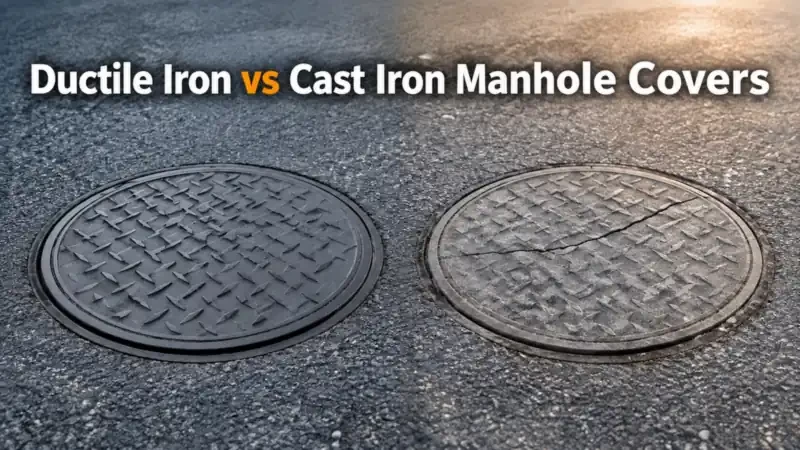
Ductile iron is a family of grades, not one material. ASTM A536 grades such as 65-45-12 and 80-55-06 define minimum tensile strength, yield strength and elongation. Good nodularity (spherical graphite) is what gives ductile iron its toughness.
Named grade with test data → predictable performance, a fair price.
Unspecified "ductile iron" → you cannot tell whether you are buying ductile iron or a brittle grey-iron substitute.
Suspiciously light casting at a given class → likely reduced section thickness; fatigue life suffers even if a static test passes.
Weight is not a guarantee of quality, but a precise material specification is the only way to make two quotes comparable.
Factor 4: Certification and Test Documentation
Documentation is a real cost item, and skipping it is a false economy.
Table 3 — Documentation, cost effect and value
| Document | Cost effect | Value delivered |
|---|---|---|
| EN 124 load test report | Adds testing fee | Proves the class was achieved |
| Material certificate (ASTM A536) | Adds lab cost | Confirms grade and nodularity |
| Batch / heat number traceability | Minor admin cost | Links product to records |
| Dimensional drawing | Usually included | Prevents fit errors |
Making certificates a condition of payment adds a small line to the invoice and removes the largest source of acceptance disputes.
Factor 5: Coatings, Locking and Anti-Rattle Options
Base cast iron is only part of the story. Optional features each add a modest amount but change long-term cost:
Bituminous or epoxy coating — corrosion resistance in de-icing salt or marine air.
Locking mechanism — reduces theft in exposed areas.
Anti-rattle gasket / machined seating — eliminates noise complaints near housing.
Adjustable-height frame — simplifies final level matching during paving.
None of these are expensive in isolation, but a price list that omits them is not comparing like with like.
Factor 6: Order Volume, Tooling and Freight
Tooling / mould cost — custom sizes may carry a one-off charge; standard 600 mm round covers usually do not.
Volume breaks — prices typically step down at 100, 500 and 1,000+ unit thresholds.
Freight — cast iron is heavy; sea freight can rival the ex-works price on small orders. Always compare landed cost, not factory price.
Packaging — palletised and strapped loads reduce damage in transit, a small cost that protects the margin.
For a project estimate, calculate landed cost per installed cover = unit price + freight + duty + installation + expected maintenance. That is the number a purchase-price-only comparison hides.
How to Compare a Manhole Cover Price List Fairly
A manhole cover price list is only useful if every line is specified to the same level. Before you compare, normalise each quote on these seven points:
EN 124 load class and the stated test load.
Clear opening, frame outer size and frame depth.
Ductile iron grade (e.g. ASTM A536 65-45-12) and nodularity evidence.
Unit weight of lid and frame.
Included certificates and batch traceability.
Coating, locking and anti-rattle options.
Incoterms, minimum order quantity and volume breaks.
If a supplier will not state these, the low price is not a saving—it is an undefined product.
Hidden Costs That Change the Real Price
The purchase price is usually only 10–20% of what a street owner spends over a cover's life. The rest is installation, inspection, maintenance, traffic management and road reinstatement. A cover that rocks, cracks or sits proud of the pavement generates costs that dwarf the difference between a US$110 and a US$140 unit.
This is the core argument for specifying to a documented standard rather than to the lowest line on a price list. The correct D400 manhole cover price is the one attached to a cover that you only have to buy and install once.
Frequently Asked Questions
The following are the questions buyers ask most often when comparing quotations for ductile iron covers.
What is the typical price of a D400 ductile iron manhole cover?
For a standard 600 mm clear-opening round unit to EN 124 D400, indicative ex-works pricing is roughly US$90–$180. Coatings, certification, volume and freight change the final figure.
Why do two manhole cover price lists differ so much?
Usually because they are not specifying the same product. Load class, clear opening, casting weight, material grade and included documentation are the common variables. Normalise these before comparing.
Is a heavier cover always better?
No. Weight correlates with material content but not automatically with quality. Good nodularity, correct grade and proper seating matter more than mass alone.
Do I need a test certificate for every order?
At minimum, require an EN 124 load test report and a material certificate for the production batch, with a heat or batch number linking the goods to the records.
Does the listed price include shipping?
Rarely. Cast iron is heavy, and freight can be a large share of landed cost. Confirm the Incoterm and calculate landed cost per installed cover.
The Bottom Line
A ductile iron manhole cover price is the sum of six things: load class, geometry, material grade, documentation, options and order logistics. D400 sits in the middle of the range and is the default for roads, but the exact number only means something once the specification is fixed.
Use the indicative ranges in this guide to spot an outlier, then normalise every quote on the seven-point checklist above. The cheapest cover on a price list is rarely the cheapest cover over 30 years.
Next step: send suppliers your drawing with clear opening, frame size, load class and required certificates stated explicitly, and ask for a landed price at your annual volume.